



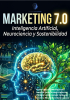
marketing vive una transformación sin precedentes. La digitalización, la inteligencia artificial, la expansión de los datos y la creciente importancia de la sostenibilidad están redefiniendo la manera en que las organizaciones comprenden a sus consumidores, diseñan estrategias y generan valor. En un entorno donde cada interacción produce información y donde los algoritmos participan activamente en las decisiones de consumo, las herramientas tradicionales resultan insuficientes para explicar la complejidad de los mercados contemporáneos.
Marketing 7.0: Inteligencia Artificial, Neurociencia y Sostenibilidad surge como una propuesta para comprender esta nueva realidad desde una perspectiva integrada. La obra parte de la idea de que la competitividad ya no depende únicamente de vender más, sino de la capacidad para interpretar datos, anticipar comportamientos, comprender los procesos cognitivos de los consumidores y actuar de manera responsable frente a los desafíos sociales y ambientales.
El consumidor actual ya no sigue recorridos lineales de decisión. Busca información, compara alternativas, interactúa con plataformas digitales y recibe recomendaciones personalizadas en tiempo real. Este fenómeno da origen al concepto de consumidor aumentado, cuyas decisiones se construyen mediante la interacción entre capacidades humanas y sistemas inteligentes.
La propuesta se articula alrededor de tres dimensiones complementarias. La primera es la inteligencia artificial, orientada a transformar datos en conocimiento capaz de describir, predecir y anticipar comportamientos. La segunda es la neurociencia, que permite comprender cómo los procesos cognitivos y emocionales influyen en la toma de decisiones. La tercera es la sostenibilidad, entendida como la incorporación de criterios económicos, sociales y ambientales en la creación de valor.
La convergencia de estas tres inteligencias constituye la esencia del Marketing 7.0. Su propósito es avanzar desde una lógica centrada en la persuasión hacia una orientada a anticipar, comprender, adaptar y regenerar. Más que una evolución tecnológica, representa una nueva forma de pensar el marketing: una disciplina capaz de integrar innovación, conocimiento humano y responsabilidad para construir organizaciones competitivas, confiables y sostenibles en el largo plazo.
Adomavicius, G., Bockstedt, J. C., Curley, S. P., & Zhang, J. (2013). Do Recommender Systems Manipulate Consumer Preferences? A Study of Anchoring Effects. Information Systems Research, 24(4), 956-975. https://doi.org/10.1287/isre.2013.0497
Agarwal, S., Kweh, Q. L., Goh, K. W., & Wider, W. (2025). Redefining marketing strategies through sustainability: Influencing consumer behavior in the circular economy: A systematic review and future research roadmap. Cleaner And Responsible Consumption, 18, 100298. https://doi.org/10.1016/j.clrc.2025.100298
Aljumah, A. I., Nuseir, M. T., ElRefae, G., & Fararah, F. S. (2026). AI-powered smart distribution and firm performance through sustainable digital marketing innovation and sustainability commitment. Discover Sustainability, 7(1). https://doi.org/10.1007/s43621-026-03617-8
Alsaffarini, E., & Awwad, B. S. (2026). Artificial Intelligence in Sustainable Marketing: How AI Personalization Impacts Consumer Purchase Decisions. Sustainability, 18(2), 1123. https://doi.org/10.3390/su18021123
Alshaketheep, K., Al-Ahmed, H., & Mansour, A. (2025). RETRACTED: Beyond purchase patterns: harnessing predictive analytics to anticipate unarticulated consumer needs. Acta Psychologica, 257, 105089. https://doi.org/10.1016/j.actpsy.2025.105089
Alsharif, A. H., Wang, J., Isa, S. M., Salleh, N. Z. M., Dawas, H. A., & Alsharif, M. H. (2025). The synergy of neuromarketing and artificial intelligence: A comprehensive literature review in the last decade. Future Business Journal, 11(1). https://doi.org/10.1186/s43093-025-00591-x
Antonetti, P., & Maklan, S. (2014). Exploring Postconsumption Guilt and Pride in the Context of Sustainability. Psychology And Marketing, 31(9), 717-735. https://doi.org/10.1002/mar.20730
Antonetti, P., & Maklan, S. (2014). Feelings that Make a Difference: How Guilt and Pride Convince Consumers of the Effectiveness of Sustainable Consumption Choices. Journal Of Business Ethics, 124(1), 117-134. https://doi.org/10.1007/s10551-013-1841-9
Aoki, T., & Matsui, A. (2025). Does algorithmic recommendation complement or substitute advertising and influencers? Consumer attitudes toward recommendation information and the formation of purchase intentions. Computers In Human Behavior, 172(172), 108735. https://doi.org/10.1016/j.chb.2025.108735
Ariely, D., & Berns, G. S. (2010). Neuromarketing: the hope and hype of neuroimaging in business. Nature Reviews. Neuroscience, 11(4), 284-292. https://doi.org/10.1038/nrn2795
Atas, M., Felfernig, A., Polat-Erdeniz, S., Popescu, A., Tran, T. N. T., & Uta, M. (2021). Towards psychology-aware preference construction in recommender systems: Overview and research issues. Journal Of Intelligent Information Systems, 57(3), 467-489. https://doi.org/10.1007/s10844-021-00674-5
Balaskas, S. (2026). From Recommendations to Delegation: A Systematic Review Mapping Agentic AI in E-Commerce and Its Consumer Effects. Information, 17(3), 222. https://doi.org/10.3390/info17030222
Bilgihan, A., Ostinelli, M., Lorenz, M., & Zhang, Y. (2026). The AI Agent in the Room: Rethinking Consumer Decision‐Making in the Age of Autonomous AI. Psychology And Marketing. https://doi.org/10.1002/mar.70165
Bryła, P., Chatterjee, S., & Ciabiada-Bryła, B. (2022). The Impact of Social Media Marketing on Consumer Engagement in Sustainable Consumption: A Systematic Literature Review. International Journal Of Environmental Research And Public Health, 19(24), 16637. https://doi.org/10.3390/ijerph192416637
Chernev, A., Böckenholt, U., & Goodman, J. (2014). Choice overload: A conceptual review and meta‐analysis. Journal Of Consumer Psychology, 25(2), 333-358. https://doi.org/10.1016/j.jcps.2014.08.002
Christensen, J. F., Farahi, F., Vartanian, M., & Yazdi, S. H. N. (2022). Choice Hygiene for “Consumer Neuroscientists”? Ethical Considerations and Proposals for Future Endeavours. Frontiers In Neuroscience, 15, 612639. https://doi.org/10.3389/fnins.2021.612639
Dangelico, R. M., & Vocalelli, D. (2017). “Green Marketing”: An analysis of definitions, strategy steps, and tools through a systematic review of the literature. Journal Of Cleaner Production, 165, 1263-1279. https://doi.org/10.1016/j.jclepro.2017.07.184
Delmas, M. A., & Burbano, V. C. (2011). The Drivers of Greenwashing. California Management Review, 54(1), 64-87. https://doi.org/10.1525/cmr.2011.54.1.64
Eyasu, A., & Negash, M. (2026). How and when green marketing works: a systematic review of consumer responses, moderators, and boundary conditions. Future Business Journal, 12(1). https://doi.org/10.1186/s43093-026-00839-0
Fan, Y., & Liu, X. (2022). Exploring the role of AI algorithmic agents: The impact of algorithmic decision autonomy on consumer purchase decisions. Frontiers In Psychology, 13, 1009173. https://doi.org/10.3389/fpsyg.2022.1009173
Ferrell, M. L., Beatty, A., & Dubljevic, V. (2025). The Ethics of Neuromarketing: A Rapid Review. Neuroethics, 18(1). https://doi.org/10.1007/s12152-025-09591-8
Garg, V., Bohara, S., & Srivastav, A. (2025). AI-driven sustainability marketing transforming consumers’ perception toward eco-friendly brands. Discover Sustainability, 6(1). https://doi.org/10.1007/s43621-025-01934-y
Geissdoerfer, M., Savaget, P., Bocken, N. M., & Hultink, E. J. (2016). The Circular Economy – A new sustainability paradigm? Journal Of Cleaner Production, 143, 757-768. https://doi.org/10.1016/j.jclepro.2016.12.048
Gleim, M. R., Smith, J. S., Andrews, D., & Cronin, J. J. (2012). Against the Green: A Multi-method Examination of the Barriers to Green Consumption. Journal Of Retailing, 89(1), 44-61. https://doi.org/10.1016/j.jretai.2012.10.001
Goldhaber, M. H. (1997). The attention economy and the Net. First Monday. https://doi.org/10.5210/fm.v2i4.519
Goncalves, M., Hu, Y., Aliagas, I., & Cerdá, L. M. (2024). Neuromarketing algorithms’ consumer privacy and ethical considerations: challenges and opportunities. Cogent Business & Management, 11(1). https://doi.org/10.1080/23311975.2024.2333063
Gupta, R., Kapoor, A. P., & Verma, H. V. (2025). Neuro-insights: a systematic review of neuromarketing perspectives across consumer buying stages. Frontiers In Neuroergonomics, 6, 1542847. https://doi.org/10.3389/fnrgo.2025.1542847
Huang, M., & Rust, R. T. (2020). A strategic framework for artificial intelligence in marketing. Journal Of The Academy Of Marketing Science, 49(1), 30-50. https://doi.org/10.1007/s11747-020-00749-9
Joshi, Y., & Rahman, Z. (2015). Factors Affecting Green Purchase Behaviour and Future Research Directions. International Strategic Management Review, 3(1-2), 128-143. https://doi.org/10.1016/j.ism.2015.04.001
Kirchherr, J., Reike, D., & Hekkert, M. (2017). Conceptualizing the circular economy: An analysis of 114 definitions. Resources Conservation And Recycling, 127, 221-232. https://doi.org/10.1016/j.resconrec.2017.09.005
Kizilcec, R. F. (2016). How much information?: Effects of transparency on trust in an Algorithmic interface. ACM Digital Library, 2390-2395. https://doi.org/10.1145/2858036.2858402
Lyon, T. P., & Montgomery, A. W. (2015). The Means and End of Greenwash. Organization & Environment, 28(2), 223-249. https://doi.org/10.1177/1086026615575332
McCarthy, B. (2024). Can generative artificial intelligence help or hinder sustainable marketing? Journal Of Resilient Economies (ISSN 2653-1917), 4(2). https://doi.org/10.25120/jre.4.2.2024.4153
Mourali, M., Novakowski, D., Pogacar, R., & Brigden, N. (2024b). Post hoc explanations improve consumer responses to algorithmic decisions. Journal Of Business Research, 186, 114981. https://doi.org/10.1016/j.jbusres.2024.114981
Nyilasy, G., Gangadharbatla, H., & Paladino, A. (2013). Perceived Greenwashing: The Interactive Effects of Green Advertising and Corporate Environmental Performance on Consumer Reactions. Journal Of Business Ethics, 125(4), 693-707. https://doi.org/10.1007/s10551-013-1944-3
Peattie, K., & Belz, F. (2010). Sustainability marketing — An innovative conception of marketing. Marketing Review St Gallen, 27(5), 8-15. https://doi.org/10.1007/s11621-010-0085-7
Plassmann, H., Ramsøy, T. Z., & Milosavljevic, M. (2012). Branding the brain: A critical review and outlook. Journal Of Consumer Psychology, 22(1), 18-36. https://doi.org/10.1016/j.jcps.2011.11.010
Rohden, S. F., & Espartel, L. B. (2024). Consumer reactions to technology in retail: choice uncertainty and reduced perceived control in decisions assisted by recommendation agents. Electronic Commerce Research, 24(2), 901-923. https://doi.org/10.1007/s10660-024-09808-7
Shin, D. (2020). The effects of explainability and causability on perception, trust, and acceptance: Implications for explainable AI. International Journal Of Human-Computer Studies, 146, 102551. https://doi.org/10.1016/j.ijhcs.2020.102551
Van Hau, P., Strong, C., & Thaichon, P. (2026). AI-driven marketing and sustainability: from intelligent persuasion to responsible market transformation. Journal Of Strategic Marketing, 1-14. https://doi.org/10.1080/0965254x.2026.2705205
Wang, J., & Wu, L. (2016). The impact of emotions on the intention of sustainable consumption choices: evidence from a big city in an emerging country. Journal Of Cleaner Production, 126, 325-336. https://doi.org/10.1016/j.jclepro.2016.03.119
White, K., Habib, R., & Hardisty, D. J. (2019). How to SHIFT Consumer Behaviors to be More Sustainable: A Literature Review and Guiding Framework. Journal Of Marketing, 83(3), 22-49. https://doi.org/10.1177/0022242919825649

This work is licensed under a Creative Commons Attribution-NonCommercial-NoDerivatives 4.0 International License.